
Complete this informal talent assessment. Think about all the people you have in your organization who are in a managerial position. It doesn’t matter if that count is 2 or 200; develop a rough mental picture of all those individuals. Next, answer this question: How many of those individuals were high-producing individual contributors before they were elevated to a managerial role? Is it a notable number? Hopefully it is. That means you have great talent working for your organization. However, it could also be a sign of a leadership crisis.
From Top Performer to Struggling Manager
In my 20-plus years in the workplace learning and development field, one of the most common skill gaps I’ve encountered is a strong performer who gets promoted into a management position and consequently struggles mightily. If you have experienced that, you are not alone. All the things that contributed to their success are no longer what will drive success in their new role. They excel at getting things done, and they don’t know how to get things done through others. Left unaddressed, the employees under their care could lack clarity about expectations, a sense of empowerment, and the engagement and satisfaction they desire in their work. Not to mention that the manager probably isn’t enjoying their job very much either. One of the best ways to drive real progress and performance in your organization is to invest in developing your supervisors and managers.
The Myth of ‘No Time’ for Development
I know what you’re likely thinking: your supervisors and managers don’t have time to learn and grow. Workloads are heavy, time is of the essence, and customer demands are taking a toll. You’re also likely to think of formal learning activities such as instructor-led workshops and online learning courses. All of which requires time away from the “shop floor.” Fortunately, only about 10% of an employee’s learning comes from such sources.
Where Real Learning Happens
As you can see from the graphic below on optimal sources of learning, formal education accounts for only about 10% of development. On the other hand, informal learning accounts for 90% of an employee’s skill, knowledge, and behavior attainment. That is the unlock you may be missing. Don’t think of investing in development as a stand-alone thing. It should be incorporated into the day-to-day.
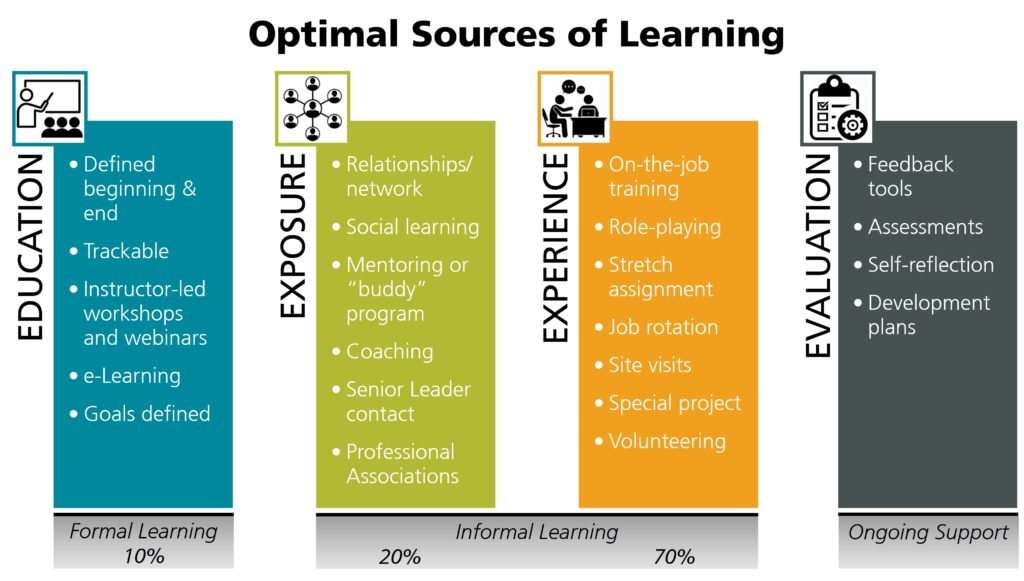
When looking for opportunities to invest in your managers’ development, lean heavily on what they can learn through experience. 70% of an employee’s learning comes from experience. This includes on-the-job training, role-playing, stretch assignments, job rotations, and special projects. In other words, they learn through doing. Oftentimes, this can be incorporated into the normal flow of work without adding extra time away from the job to be done. For your supervisors and managers, that means they need time to have meaningful conversations with their direct reports and to practice difficult conversations that require courage and confidence. It means they need to step away from the day-to-day technical work and set their team up to deliver results. Let’s explore an example.
A Real-World Example: Coaching a Struggling Supervisor
Suppose you have a supervisor who is responsible for leading daily huddles or stand-up meetings. And suppose the lack of command skills, confidence, and clear communication is hurting that supervisor’s credibility. You find that the team isn’t producing at the level it could because they have a hard time rallying around the supervisor’s unclear vision and insufficient execution. I would spend time with that supervisor and have them reflect on how they want others to experience their leadership. How do they want to be viewed by their peers and direct reports? Then lead them through an examination of how the current reality compares to their goal. That analysis should include feedback and direct observations, and perhaps even a video recording (nobody likes to do it, but there has been no more transformational development experience for me than watching myself on a recording). Next, have them practice in a safe environment to hone their skills. I acknowledge this approach requires time from you, HR, a training department, or a coach, and we have already established that you don’t have time. You can’t afford not to make time to invest in your supervisors and managers. It will pay off exponentially for you, and you may find the experience is a development opportunity for you, too.
The High Cost of Ignoring Leadership Development
According to Gallup, “The managers in your organization, more than any other factor, influence team engagement and performance. 70% of the variance in team engagement is determined solely by the manager.” Gallup goes on to say that the cost of low employee engagement is estimated at $8.8 trillion in lost productivity globally each year. Think you don’t have time to invest in the growth and development of your supervisors and managers? Can you afford not to?
